With this publication, I would like to illustrate the relationship between professional photography and graphic design.
It enables to showcase an international perspective with interesting contributions from people with great skill and influence. Not only renowned photographers are contributing such as Ryszard Horowitz, Sam Haskins, Gérardo Suter and Milton Montenegro but also emerging talents like Melissa Hribar, Linder VanderZande and Sabine Korth.
I have been working as a professional photographer for many years. In 1989 I founded CIRCLE-24, an international foundation of professional image-makers who keep each other informed about trends and developments in photography. It has evolved into a group of friends with extensive contacts across various disciplines, which gives me an enormous advantage in compiling the material for this project.
I have organized quite a number of photography exhibitions in the Netherlands and abroad. Many new trends stem from art photography. The relation between art photography, exhibition design and graphic design is obvious.
Both photography and graphic design have undergone significant changes, particularly in the 1990s, with the widespread adoption of computers. This transformation presented a considerable challenge. Developments were that fast that I wanted to restrict the contributions for this project to approximately this particulair decade. To give a complete view is impossible but I have tried to make a coherent story and a positive showcase of the rich scale of new possibilities in photography and graphic design.
By including more information about the participants I hope to encourage further insight. To make techniques more accessible there is a list of experts and books on the last page.
Contents
First, what were the most important trends in concept and visualisation and how different were these in different part of the world? How were they applied in a graphic design or exhibition?
Secondly it will become clear that also the definition of both professions, photographer and graphic designer, has changed tremendously in a short period. A photographer is no longer a photographer in the traditional meaning of the word and also the graphic design profession has changed and expanded enormously. You will be aware of the vast possibilities of new computer software and printing techniques and of the tensions this has caused between designers, digital photographers and printers, often leaving clients with the question: "Who is doing what and who is right?” About the how and why of these theoretical and technical questions a lot has been published. For many indistinctnesses nowadays solutions exist, developed by experts of the concerning specialities; solutions which have become a part of the trends and ways of working. And lastly: what will the future bring and what aspirations remain?

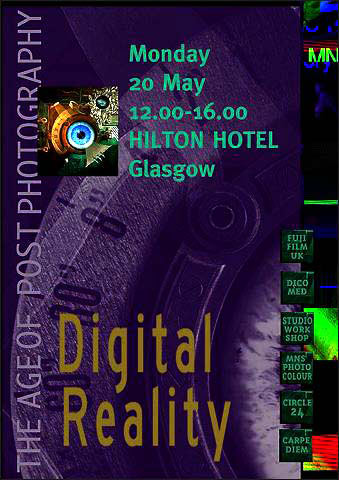
Around the same time, CIRCLE-24 organized a symposium in Glasgow to assess the current situation and future expectations.
New applications and new definitions
The techniques have evolved, what brought new possibilities. At the same time the discussion has risen to give a new meaning to the involved professions. Festivals like Montage93 (LINK) of the Rochester Institute of Technology of 1993 and the 'Design beyond Design' symposium at the Jan van Eijk Academie in Maastricht have made these changes visible. The photography festival has shown especially the rich scale of possibilities to produce an image; the Jan van Eijk Design Symposium concentrated on redefining visual communication.
At about the same time CIRCLE-24 organized s symposium in Glasgow to show and discuss what the situation was now and what to expect of the future. Studio Photography
For more than 7 years I was employed by the Design Department of Philips. After that period, when I had started my own studio, I still did a lot of work for Philips Design. Thanks to the good relationships that were maintained with Philips, I was informed well in advance that photography would play a much smaller role in the design process in the future. Also that marketing departments would use less and less photography.
Computer aided design developed to such an advanced level that photography of products became less necessary. Being a studio photographer, I worked extensively for kitchen and bathroom manufacturers. We were experienced set builders. This market also has changed tremendously. During the last decade studio photography has become more illustrative than before.
Martin Evening (LINK) predicted in 1996 that in the near future 35% less professional photographers would be needed. I'm afraid that he was right. The fact that every year thousands of young people are graduating from academies is not helping either. And it makes one wonder how they are planning to earn their money.
Computers
Nobody has foreseen the extent in which digital techniques could change the goal as well as the function of photography. Computer software like Photoshop (LINK), Eclipse and Imaginator have obscured the borders between the different disciplines and a new phenomenon 'digital image manipulation' has emerged. Every person who is a little handy with the computer can obtain fantastic results easily. Experimenting is the key to success. The program is not just there for the benefit of photographers; it has, on the contrary, also been the cause of shifts in profession. Another advantage of the computer: internet gave me the possibility to ask the same questions to all contributors of the book, whether they are experienced professionals or young designers.
Illustrative photography
By photographing the image in parts and by illustrating these parts with the computer an optimal use is made of the potential. It has become possible to achieve a whole new style with a specific image language. The end results, which started as photographs in the very beginning, make clear that most of their creators were originally photographers; they know the possibilities and boundaries of techniques.
Sometimes it seems as if photographers make photographs first of all to impress other photographers; bragging about smarter solutions and showing off possibilities and ways of expression which were still enclosed in chemical processes, are examples of that.
Also, photographers really want to make a statement that photography is an art form, which defeats the object of communication.
Intrinsic to the photographic process is that it reproduces something what has been, no matter how manipulated or altered. The use of computers makes it very well possible to mix photography with other illustrative techniques (art, painting, printing techniques) or different media (film, sound). Because the possibilities of making photographs have enlarged so much, the word photographer no longer covers the whole spectrum. In Germany the term photo-designer (Urs Schwerzmann LINK) is known for a long time and to me it seems a better name.
All these changes have given photography a different identity. Merely making a reproduction of reality (straight photography) is no longer its sole purpose. What matters more is what photographs represent. Which role will photographers be able to play in the future?
Many photographers were still very uncertain about all this digital stuff. Theywere not willing or quite able to understand what had changed. They could not accept that their profession, build up with so much care, had changed so radically. The demand for photography, the making of photos, had changed. Darkrooms were no longer necessary and all the techniques learned at school could be left behind. New skills had to be learned. We, photographers, were expected to stay informed about new possibilities and techniques, but it was a steep learning curve, not to mention the necessary financial investments to be made. Staying behind in this commercial rat race would mean irrevocably a restriction in potential market.
Graphic Design
For years graphic design meant the design of artwork. Because of the computer and the new media the profession had grown enormously. As graphic designers were concerned with multimedia and the web, they had to deal with more aspects than before: not only with text and images but also with film, video, sound and not to be forgotten the social aspects of 'interactivity'.
Because of the changes in content of graphic design the demand for photography has changed. Established photographers cannot fulfil this demand. The market for photography has changed!
The demands have changed that much that the work of a graduate, be it unsharp or false coloured, will sometimes be preferred over the work of a professional who is exercising his profession for 25 years. It even seems that the more rules of lighting, colour fidelity, sharpness or permanency can be thrown overboard the better it is appreciated. Blurred unsharpness, false colours, the more the better!
The LOMO is a small Russian camera, which has become very popular just because of its shaky quality; even so popular that a LOMO-culture (LOMO LINK) with a real fan club has emerged.
Trends are an interpretation of ’certain movements at the source’. We think trends, we design trends and we are inspired by trends. We borrow a little of everything and in this way try to develop our own style a little further.
Many new trends make use of graphic elements and techniques: something added to the image. A photograph with a text in it is not a graphic design though. Photographers borrow from designers and designers from photographers. We sit on each other’s chair and like to interfere in each other’s matters, matters we had no former knowledge of. Sometimes we even think to know better. This leads to strongly varying results and irritation concerning the interference of the other party.
We have a lot of know-how, but too little know-why. We know more about the world seen from space than about our neighbours. We are bombarded with information we don't need. That surplus of information influences our way of seeing. A fatigue emerges which is difficult to change into real interest.
It is not just in the profession of photographers and graphic designers that the world has changed so much during the last decade. Art has become virtual, museums have become interactive. (LINK) Moreover the changes in cultural structure demand a more careful communication in advertising and design (INIVA LINK). Contemplating on the complex cultural values has become more important now that different views meet more easily. This forms a challenge not only for investigating ways of communication but also for designers, photographers and artists (Universes LINK).
We, photographers and graphic designers, would like to communicate more with our images than merely recording the event: we desperately want to be different. Though this is not new since Marshall McLuhan (McLuhan LINK), the medium has become the message. But to throw away all our hard learned values for this, is something hard to accept. We will have to occupy ourselves more with the message, what we want to convey, than with the image itself, that is making nice pictures. It will be a challenge to build on this new tradition, making use of all the possibilities. Maybe we can learn to see again? ('Ne pas plier' LINK)
Although the problematic period for photographers is caused by a complex of factors the situation nowadays reminds me of the little boy who has been given all the possible toys he ever wanted and was thrown in a state of paralyses.
Photographers themselves will have to establish a new definition of their profession. What are the new qualities and skills a photographer will need for the future? Facing and approaching are the right solutions for (fearful) innovations. What established structures will have to disappear? What will takes its place, what will emerge after photography? Could it be, that a whole new profession will develop, combining all these specifications?